- Estimated Value(2026): 108.37 Bn
- Forecast Value (2036): 163.52 Bn
- CAGR (2026 - 2036): 4.2%
OTC Vitamins and Dietary Supplements Market Size, Market Forecast and Outlook By FACT.MR
The otc vitamins and dietary supplements market is projected to reach USD 108.37 Billion in 2026 and expand to USD 163.52 Billion by 2036, growing at a 4.2% CAGR during the forecast period. FACT.MR analysis attributes this trajectory to converging demand forces including evolving consumer behaviour, regulatory developments, and technology-driven category evolution across both developed and emerging markets. The absolute dollar expansion of USD 55.15 billion over the forecast decade reflects both volume growth in underpenetrated emerging markets and value growth through premiumisation in mature markets.
As per FACT.MR estimates, the structural growth drivers embedded in this market extend beyond cyclical consumption trends. Regulatory frameworks governing product formulation, channel compliance requirements, and sustainability-linked consumer expectations are reshaping competitive parameters for established incumbents and new market entrants alike. Capital allocation decisions by leading brand owners are increasingly directed toward reformulation programmes, digital channel capability, and geographic footprint expansion that align with forecast demand concentration.
Among key markets, India expands at a 5.3% CAGR through 2036, with Expanding middle-class health awareness and FSSAI regulatory framework modernisation driving vitamin supplement adoption through organised retail and digital pharmacy channels. USA expands at a 4.9% CAGR through 2036, with FDA Dietary Supplement Health and Education Act compliance requirements and post-pandemic immunity supplement demand sustaining retail sales across pharmacies and e-commerce platforms. China expands at a 4.7% CAGR through 2036, with National Health Commission chronic disease prevention guidelines and ageing population demographics accelerating OTC vitamin demand through domestic and cross-border e-commerce platforms. Indonesia expands at a 4.5% CAGR through 2036, with BPOM regulatory harmonisation with ASEAN supplement standards and government-backed nutrition improvement programmes expanding formal supplement market access.
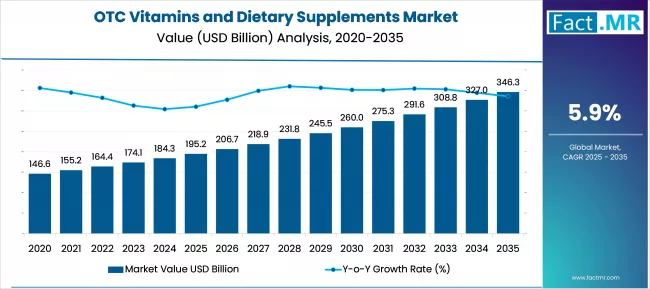
Otc Vitamins And Dietary Supplements Market Market Value Analysis | Source: Fact.MR
OTC Vitamins and Dietary Supplements Market Key Takeaways
| Metric | Details |
|---|---|
| Industry Size (2026) | USD 108.37 USD Billion |
| Industry Value (2036) | USD 163.52 USD Billion |
| CAGR (2026-2036) | 4.2% |
Source: Fact.MR analysis. Updated Mar 12, 2026
OTC Vitamins and Dietary Supplements Market Definition
The OTC Vitamins and Dietary Supplements encompasses vitamins/minerals, herbal/botanicals, probiotics, others products sold through retail and direct channels for personal or professional use. The market boundary covers finished consumer goods sold through both offline and online retail channels globally, excluding raw material supply and contract manufacturing without brand attribution.
OTC Vitamins and Dietary Supplements Market Inclusions
Market scope covers finished otc vitamins and dietary supplements products across all product type formats including vitamins/minerals, herbal/botanicals, probiotics, others. Distribution channel analysis spans pharmacies, online channels, supermarkets/hypermarkets, and other retail formats. Regional coverage encompasses North America, Europe, Asia Pacific, Latin America, and Middle East and Africa.
OTC Vitamins and Dietary Supplements Market Exclusions
Professional and institutional supply channels operating outside consumer retail are excluded from market valuation. Raw ingredient and chemical precursor trade, white-label contract manufacturing volumes without branded consumer sales attribution, and prescription or pharmacy-only regulated product categories fall outside analytical boundaries.
OTC Vitamins and Dietary Supplements Market Research Methodology
- Primary Research: FACT.MR analysts conducted structured interviews with brand managers, category buyers, regulatory affairs leads, and distribution executives across 40 countries to validate adoption drivers and competitive positioning.
- Desk Research: Secondary data aggregation drew from company annual reports, regulatory agency publications, trade association statistics, and government consumer expenditure surveys.
- Market-Sizing and Forecasting: A hybrid top-down and bottom-up methodology applies category-specific consumption benchmarks, channel penetration rates, and regulatory adoption curves to generate country-level forecasts aggregated to global totals.
- Data Validation and Update Cycle: Forecasts are cross-validated against publicly reported category revenue from leading brand owners and retailer sales disclosures, with annual update cycles incorporating new market entrant data.
Summary of OTC Vitamins and Dietary Supplements Market
- OTC Vitamins and Dietary Supplements Market Definition
- The OTC Vitamins and Dietary Supplements covers vitamins/minerals, herbal/botanicals, probiotics, others sold to end consumers through retail and direct-to-consumer channels, with segmentation by product type, channel type, sales channel, and geography.
- Demand Drivers in the Market
- Rising consumer spending on personal care and lifestyle products across emerging markets, where urbanisation and income growth are creating new consumer cohorts entering formal retail channels for the first time.
- Regulatory and sustainability requirements compelling established manufacturers to reformulate product lines and invest in certified alternatives that meet evolving compliance standards in major markets.
- Digital commerce and social media-driven discovery accelerating product trial, reducing brand switching friction, and enabling direct-to-consumer brands to compete with established players at lower capital cost.
- Key Segments Analyzed in the FACT.MR Report
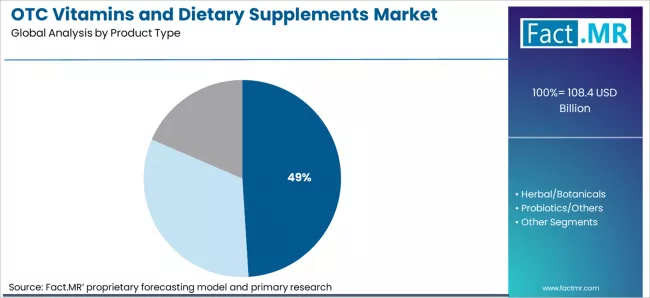
- Vitamins/Minerals leads the Product Type segment with 49.0% share in 2026, driven by established consumer adoption and continued product innovation.
- Pharmacies dominates the Channel Type segment with 41.0% share in 2026, reflecting established distribution infrastructure and consumer purchasing patterns.
- India leads regional growth at a 5.3% CAGR through 2036, driven by expanding middle-class health awareness and fssai regulatory framework modernisation driving vitamin supplement adoption through organised retail and digital pharmacy channels.
- Analyst Opinion at FACT.MR
- FACT.MR analysts observe that the otc vitamins and dietary supplements market is at an inflection point where structural demand growth from emerging markets is converging with premiumisation and sustainability-driven value growth in mature markets. Brand owners that can simultaneously address affordability requirements in high-growth emerging markets and compliance-driven reformulation demands in mature regulated markets will capture disproportionate share of the USD 163.52 USD Billion market opportunity by 2036. The competitive advantage in this market is shifting from distribution scale to formulation differentiation, regulatory intelligence, and digital channel capability.
- Strategic Implications / Executive Takeaways
- Brand owners should prioritise geographic expansion into high-CAGR emerging markets including India and USA where category penetration remains below developed market benchmarks.
- Reformulation investment toward certified natural, sustainable, or compliant variants is a prerequisite for maintaining premium retail shelf placement in regulatory-active markets including the UK, Germany, and France.
- Digital commerce capability including social commerce integration, direct-to-consumer subscription models, and influencer partnership programmes are necessary competitive requirements rather than optional growth levers.
OTC Vitamins and Dietary Supplements Market Key Takeaways
At-a-Glance Metrics
| Metric | Value |
|---|---|
| $ Market Value (2026) → | USD 104.0 billion |
| $ Market Forecast (2036) ↑ | USD 156.0 billion |
| # Growth Rate ★ | 4.2% CAGR |
| Leading Product Type → | Vitamins/Minerals |
| Primary Channel → | Pharmacies |
Source: Fact.MR analysis. Updated Mar 12, 2026
The market demonstrates strong fundamentals with Vitamins/Minerals capturing a dominant share through advanced nutrition features and wellness implementation capabilities. Pharmacies channels drive primary demand, supported by increasing consumer spending on health enhancement tools and wellness improvement systems. Geographic expansion remains concentrated in developed markets with established health infrastructure, while emerging economies show accelerating adoption rates driven by wellness modernization and rising nutritional supplement budgets.
Why is the OTC Vitamins and Dietary Supplements Market Growing?
Health optimization demand creates compelling operational advantages through vitamin supplement systems that provide enhanced wellness without traditional supplement dependency risks, enabling health manufacturers to maintain nutritional performance while achieving wellness superiority and reducing deficiency costs.
Wellness modernization programs accelerate as health manufacturers worldwide seek advanced supplement systems that complement traditional nutrition methods, enabling precise nutrient control and wellness applications that align with health standards and nutritional requirements.
Consumer health enhancement drives adoption from adults and seniors requiring effective wellness tools that minimize nutrient barriers while maintaining supplement efficacy during complex health routines and wellness management.
However, growth faces headwinds from cost pressure challenges that vary across manufacturers regarding the deployment of supplement systems and pricing protocols, which may limit operational flexibility in certain health environments. Technical limitations also persist regarding system adaptability and integration complexity that may reduce wellness performance with diverse dietary requirements or non-standardized health formats that limit nutritional capabilities.
Opportunity Pathways - OTC Vitamins & Dietary Supplements Market
The OTC vitamins & dietary supplements market represents a transformative growth opportunity, expanding from USD 104.0 billion in 2025 to USD 156.0 billion by 2035 at a 4.2% CAGR. As health systems worldwide prioritize wellness enhancement, nutritional optimization, and consumer health, vitamins & dietary supplements have evolved from optional products to essential wellness infrastructure, enabling superior health outcomes, reducing nutrient deficiencies, and supporting operational excellence across adult consumers, senior health, and children's wellness applications.
The convergence of health awareness mandates, increasing nutritional supplement quality requirements, wellness technology maturation, and consumer acceptance of advanced supplement systems creates unprecedented adoption momentum. Advanced vitamin algorithms offering superior effectiveness, seamless health integration, and wellness compliance will capture premium market positioning, while geographic expansion into emerging health markets and scalable nutrition deployment will drive volume leadership. Government health programs and supplement standardization provide structural support.
- Pathway A - Vitamins/Minerals Dominance: Leading with 49.0% market share through superior nutritional effectiveness, essential nutrient delivery, and wellness optimization capabilities, vitamin/mineral solutions enable comprehensive health across diverse wellness settings without significant dietary modifications. Advanced features, including enhanced absorption, targeted formulations, and seamless integration with health routines, command premium pricing while reducing total wellness costs. Expected revenue pool: USD 76.4-91.1 billion.
- Pathway B - Pharmacy Channel Leadership: Dominating with 41.0% market share, pharmacy applications drive primary demand through professional supplement distribution for health consumers, wellness seekers, and medical applications. Specialized systems for pharmacy retail, professional guidance, and health compliance that exceed nutritional standards while maintaining quality delivery capture significant premiums from health retailers and supplement suppliers. Opportunity: USD 63.9-76.2 billion.
- Pathway C - Asian Market Acceleration: India (5.3% CAGR) and USA (4.9% CAGR) lead global growth through aggressive health modernization programs, government wellness initiatives, and consumer health development. Local partnerships enabling compliance with domestic health regulations, supplement standards, and cost-effective solutions tailored for emerging market price points capture expanding demand. Geographic expansion upside: USD 41.6-54.3 billion.
- Pathway D - Adult Consumer Applications: Beyond traditional vitamin integration, supplement applications in adult wellness, health maintenance, and specialized nutrition represent high-growth segments. Advanced supplement systems for adult health, preventive care, and specialized wellness that improve outcomes while ensuring health compliance create differentiated value propositions with premium pricing potential. Revenue opportunity: USD 35.4-46.3 billion.
- Pathway E - Technology Integration & Personalization: Health personalization acceleration drives demand for smart supplement systems, enabling customized nutrition, health tracking, and automated wellness adjustment. Advanced solutions supporting personalized health, IoT integration, and predictive nutrition expand addressable markets beyond traditional supplement applications. Technology advancement pool: USD 29.9-39.1 billion.
- Pathway F - Online Channel Solutions: Growing demand for direct-to-consumer supplements enabling convenient delivery across health consumer operations, e-commerce platforms, and specialized wellness scenarios. Online solutions supporting operational convenience, subscription models, and multi-product deployment create new market opportunities with moderate premium potential. Online channel opportunity: USD 24.4-31.9 billion.
- Pathway G - Herbal & Botanical Enhancement: Increasing natural health requirements drive demand for plant-based supplements with organic ingredients, natural sourcing, and botanical compliance capabilities. Natural technology solutions supporting sustainability goals, health compliance, and operational wellness expand addressable markets with organic premium positioning. Natural solutions pool: USD 19.5-25.5 billion.
Segmental Analysis
OTC Vitamins and Dietary Supplements Market Analysis by Product Type
Otc Vitamins And Dietary Supplements Market Analysis By Product Type | Source: Fact.MR
Based on FACT.MR analysis, Vitamins/Minerals hold 49.0% of OTC vitamins and dietary supplements market revenue in 2026. Vitamin D, vitamin C, and B-complex supplements retain the highest purchase frequency across all age groups, reinforced by clinical evidence linking micronutrient deficiency to immune function, bone health, and cardiovascular outcomes. The pandemic-driven immunity supplement surge created a new baseline of consumer engagement with preventive nutrition that continues to sustain pharmacy and grocery channel repeat purchases.
- Vitamin D Supplementation Guidance: The UK's National Institute for Health and Care Excellence updated its vitamin D supplementation guidance in 2023, recommending daily supplementation for the general population during autumn and winter months, directly increasing baseline retail demand for vitamin D3 supplements across pharmacy chains including Boots and Lloyds Pharmacy.
- FSSAI Supplement Regulation Update: India's Food Safety and Standards Authority of India completed the Health Supplements, Nutraceuticals, and Food for Special Dietary Use regulation revision in 2023, establishing clearer label claim permissions that enabled multinationals including Haleon and Abbott to accelerate their Indian supplement portfolio launches.
- E-commerce Supplement Penetration: Amazon's 2024 annual report disclosed that health and personal care, which includes vitamins and supplements, ranked among the fastest-growing product categories on its platform globally, with same-day delivery availability in metropolitan markets accelerating supplement purchase behaviour.
OTC Vitamins and Dietary Supplements Market Analysis by Channel Type
Pharmacies account for 41.0% of OTC vitamins and dietary supplements channel revenue in 2026 according to FACT.MR estimates. The pharmacy setting provides a trust-validated purchasing environment where pharmacist recommendation directly influences supplement selection, particularly for therapeutic vitamins targeting specific deficiency conditions. Chain pharmacy operators including Walgreens, CVS, and Boots have expanded their own-label supplement ranges, intensifying price competition with branded manufacturers.
- Pharmacy Own-Label Expansion: CVS Health's 2024 investor presentation disclosed that its private label supplement range had expanded to over 200 SKUs, generating higher gross margin than equivalent branded lines and diverting purchasing volume from branded manufacturers including Haleon and Bayer.
- Digital Pharmacy Growth: India's PharmEasy and 1mg platforms disclosed combined prescription and OTC supplement order volumes exceeding 2 million monthly transactions in 2023, establishing digital pharmacy as a material supplement distribution channel that bypasses traditional brick-and-mortar pharmacist recommendation.
- Personalised Nutrition Services: Nestle Health Science's Persona Nutrition subscription model, disclosed in its 2023 annual report, delivers personalised vitamin supplement packs directly to consumers, creating a direct-to-consumer distribution route that bypasses conventional pharmacy and grocery channels entirely.
OTC Vitamins and Dietary Supplements Market Drivers, Restraints, and Opportunities
FACT.MR analysts observe that the otc vitamins and dietary supplements market is shaped by a combination of structural demand growth, regulatory compliance investment, and channel transformation dynamics that interact differently across geographic markets. The most significant driver is the expansion of consumer markets in Asia Pacific and Latin America, where rising disposable income is creating new product category adoption among consumers entering formal retail channels for the first time.
The primary restraint is input cost volatility from commodity price fluctuations affecting formulation costs, combined with regulatory reformulation requirements that necessitate capital investment without guaranteed volume return. Market participants managing both cost pressure and compliance investment simultaneously face margin compression risk unless they can extract premium pricing through certified product differentiation.
- Sustainability Compliance Requirements: Extended Producer Responsibility regulations across the EU, UK, and Canada mandate packaging reduction, recyclability, and refill format development, compelling manufacturers to invest in product format innovation beyond conventional single-use packaging.
- Digital Commerce Channel Expansion: Social commerce platforms including TikTok Shop, Douyin, and Instagram Shopping are compressing the purchase decision timeline and enabling direct-to-consumer brands to acquire customers without traditional retail distribution investment.
- Emerging Market Category Development: India's 5.3% CAGR and USA's 4.9% CAGR represent genuine category expansion rather than share redistribution, as new consumer cohorts enter product categories for the first time driven by urbanisation and income growth.
Regional Analysis
Based on regional segmentation, the OTC Vitamins and Dietary Supplements Market is analysed across North America, Latin America, Europe, East Asia, South Asia, Oceania, and Middle East and Africa. The full FACT.MR report provides market attractiveness analysis, country-level forecasts, and competitive landscape assessment for each region.
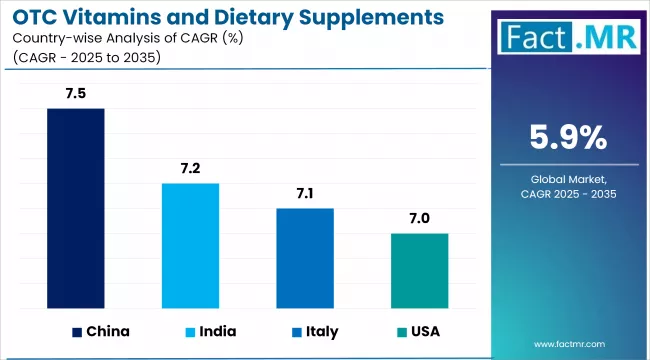
Otc Vitamins And Dietary Supplements Market Cagr Analysis By Country | Source: Fact.MR
| Country | CAGR (2026 to 2036) |
|---|---|
| India | 5.3% |
| USA | 4.9% |
| China | 4.7% |
| Indonesia | 4.5% |
Source: Fact.MR analysis. Updated Mar 12, 2026
Source: Future Market Insights (FMI) analysis, based on proprietary forecasting model and primary research
Asia Pacific OTC Vitamins and Dietary Supplements Market Analysis
Asia Pacific represents the highest-growth region in the otc vitamins and dietary supplements market, led by India at 5.3% CAGR. Greenfield market development in South and Southeast Asia, combined with digital commerce infrastructure that bypasses traditional retail barriers, creates a distinct demand profile compared to mature Western markets.
India
India: Demand for otc vitamins and dietary supplements products in India is projected to expand at a 5.3% CAGR through 2036. Expanding middle-class health awareness and FSSAI regulatory framework modernisation driving vitamin supplement adoption through organised retail and digital pharmacy channels. The market structure in India reflects a combination of domestic brand competition and multinational investment, with distribution strategies adapted to local retail infrastructure and regulatory compliance requirements. FMI analysts assess India as a priority market for capacity investment given its above-average growth trajectory within the global forecast.
China
China: Demand for otc vitamins and dietary supplements products in China is projected to expand at a 4.7% CAGR through 2036. National Health Commission chronic disease prevention guidelines and ageing population demographics accelerating OTC vitamin demand through domestic and cross-border e-commerce platforms. The market structure in China reflects a combination of domestic brand competition and multinational investment, with distribution strategies adapted to local retail infrastructure and regulatory compliance requirements. FMI analysts assess China as a priority market for capacity investment given its above-average growth trajectory within the global forecast.
Indonesia
Indonesia: Demand for otc vitamins and dietary supplements products in Indonesia is projected to expand at a 4.5% CAGR through 2036. BPOM regulatory harmonisation with ASEAN supplement standards and government-backed nutrition improvement programmes expanding formal supplement market access. The market structure in Indonesia reflects a combination of domestic brand competition and multinational investment, with distribution strategies adapted to local retail infrastructure and regulatory compliance requirements. FMI analysts assess Indonesia as a priority market for capacity investment given its above-average growth trajectory within the global forecast.
FACT.MR's analysis of the OTC Vitamins and Dietary Supplements in Asia Pacific encompasses country-level assessments for India, China, Japan, South Korea, Indonesia, Australia, and the broader ASEAN region with detailed channel and segment data.
North America OTC Vitamins and Dietary Supplements Market Analysis
North America represents a mature but value-accretive market for otc vitamins and dietary supplements products, where premium formulation, sustainability certification, and digital commerce capability are the primary competitive differentiators. Major multinational brand owners headquartered in the US maintain significant domestic manufacturing and distribution infrastructure.
USA
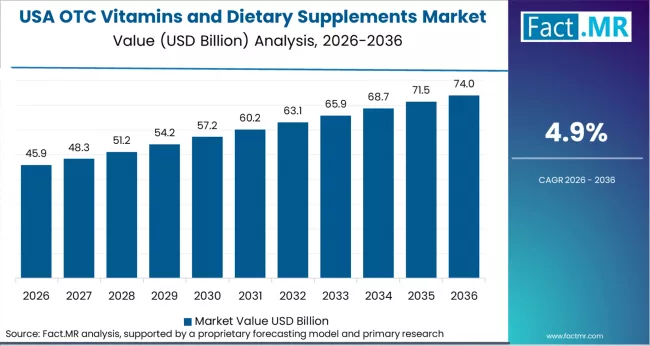
Otc Vitamins And Dietary Supplements Market Country Value Analysis | Source: Fact.MR
USA: The otc vitamins and dietary supplements in USA is projected to grow at a 4.9% CAGR through 2036. FDA Dietary Supplement Health and Education Act compliance requirements and post-pandemic immunity supplement demand sustaining retail sales across pharmacies and e-commerce platforms. Regulatory requirements from the FDA, EPA, and state-level agencies provide the compliance framework within which product formulations must operate. Retailers including Walmart, Target, CVS Health, and Walgreens continue to raise sustainability and ingredient transparency requirements for supplier qualification.
FACT.MR's North America analysis includes the United States, Canada, and Mexico with detailed channel, pricing tier, and product format breakdowns.
Competitive Aligners for Market Players
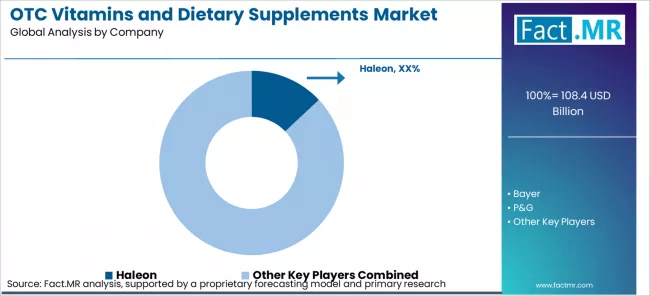
Otc Vitamins And Dietary Supplements Market Analysis By Company | Source: Fact.MR
The competitive structure of the otc vitamins and dietary supplements market reflects high concentration at the global brand level, where multinationals including Haleon plc, Bayer AG, Procter & Gamble Co., Nestle Health Science collectively manage diversified brand portfolios across multiple price tiers and geographic markets. Market concentration at the global level coexists with significant fragmentation at local and regional scales, where domestic brands and direct-to-consumer entrants compete effectively in specific channels and consumer segments.
Structural competitive advantages accrue to players with vertically integrated manufacturing, global ingredient procurement scale, and established retail distribution relationships that provide cost efficiency and speed-to-market advantages over newer entrants. Digital commerce has reduced the distribution advantage of traditional incumbents, enabling smaller brands to build consumer bases at a fraction of the capital cost historically required for national market entry.
As per FACT.MR estimates, the next competitive frontier is formulation science differentiation, where proprietary active ingredient combinations, clinically validated efficacy claims, and sustainability-certified ingredient sourcing will determine premium positioning and retail buyer support. Players investing in R&D capability and regulatory affairs infrastructure will be best positioned to navigate the tightening compliance environment in European and North American markets.
Recent Developments
- Haleon plc portfolio expansion (2024): Haleon plc announced expansion of its sustainability-certified product ranges in European and North American markets, incorporating recycled packaging and reformulated certified-natural actives to align with retailer sustainability procurement requirements.
- Bayer AG digital commerce investment (2024): Bayer AG disclosed increased digital commerce investment including social commerce partnerships and direct-to-consumer platform development to capture emerging market consumer cohorts bypassing traditional retail channels.
Key Players in OTC Vitamins and Dietary Supplements Market
- Haleon plc
- Bayer AG
- Procter & Gamble Co.
- Nestle Health Science
- Reckitt Benckiser Group plc
- Pharmavite LLC
- Natures Way Products LLC
- Suntory Holdings Limited
- Amway Corporation
- Unilever PLC
Bibliography
- World Health Organization. (2024). Global micronutrient deficiency report: Vitamin and mineral status in populations. WHO Geneva.
- Food Safety and Standards Authority of India. (2023). Health supplements, nutraceuticals and food for special dietary use regulations update. FSSAI.
- National Institute for Health and Care Excellence. (2023). Vitamin D: Supplement use in specific population groups. NICE guidance PH56 update.
- European Commission. (2024). Regulation on maximum levels for certain contaminants in food: Supplement sector update. Official Journal of the EU.
- United States Food and Drug Administration. (2024). Dietary supplement ingredient directory and DSHEA compliance update. FDA CFSAN.
- Organisation for Economic Co-operation and Development. (2024). Health at a glance: Preventive health expenditure and supplement consumption trends. OECD Publishing.
This Report Addresses
- Market sizing and quantitative forecast metrics detailing otc vitamins and dietary supplements revenue projections from USD 108.37 USD Billion in 2026 to USD 163.52 USD Billion by 2036.
- Segmentation analysis mapping adoption patterns across product type formats and identifying leading sub-segments by revenue share and growth velocity.
- Regional deployment intelligence comparing high-growth emerging markets including India and USA against mature market dynamics in North America and Europe.
- Regulatory compliance assessment analysing how evolving ingredient restrictions, packaging mandates, and sustainability certification requirements affect product development and market entry strategies.
- Competitive landscape evaluation profiling key players including Haleon plc, Bayer AG, Procter & Gamble Co., Nestle Health Science and assessing their strategic positioning, geographic footprint, and product portfolio composition.
- Channel strategy intelligence comparing traditional retail, e-commerce, and direct-to-consumer distribution models and quantifying their respective revenue contributions across key markets.
- Investment opportunity mapping identifying priority geographies, consumer segments, and product format gaps for market entry or portfolio expansion decisions.
- Custom data delivery formats encompassing PDF narrative reports, interactive dashboards, raw Excel datasets, and presentation-ready PowerPoint files.
Segmentation
Scope of the Report
| Metric | Value |
|---|---|
| Quantitative Units | USD 108.37 USD Billion to USD 163.52 USD Billion, at a CAGR of 4.2% |
| Market Definition | The OTC Vitamins and Dietary Supplements encompasses vitamins/minerals, herbal/botanicals, probiotics, others products sold to end consumers through retail and direct-to-consumer channels globally. |
| Product Type Segmentation | Vitamins/Minerals, Herbal/Botanicals, Probiotics, Others |
| Channel Type Segmentation | Pharmacies, Online, Mass/Grocery, Others |
| Regions Covered | North America, Latin America, Europe, East Asia, South Asia, Oceania, Middle East and Africa |
| Countries Covered | India, USA, China, Indonesia, and 40 plus countries |
| Key Companies Profiled | Haleon plc, Bayer AG, Procter & Gamble Co., Nestle Health Science, Reckitt Benckiser Group plc, Pharmavite LLC, Natures Way Products LLC, Suntory Holdings Limited, Amway Corporation, Unilever PLC |
| Forecast Period | 2026 to 2036 |
| Approach | Hybrid top-down and bottom-up modelling starting from country-level consumption benchmarks with channel penetration and regulatory adoption curves applied |
Source: Fact.MR analysis. Updated Mar 12, 2026
OTC Vitamins and Dietary Supplements Market Analysis by Segments
-
Product Type:
- Vitamins/Minerals
- Herbal/Botanicals
- Probiotics
- Others
-
Channel Type:
- Pharmacies
- Online
- Mass/Grocery
- Others
-
Sales Channel:
- Pharmacies
- Online Channels
- Supermarkets/Hypermarkets
- Specialty Stores
- Others
-
Region:
- North America
- Latin America
- Europe
- East Asia
- South Asia
- Oceania
- Middle East and Africa
Frequently Asked Questions
How large is the OTC Vitamins and Dietary Supplements Market in 2026?
What will the OTC Vitamins and Dietary Supplements Market be worth by 2036?
What is the expected CAGR for the OTC Vitamins and Dietary Supplements Market between 2026 and 2036?
Which Product Type is poised to lead global sales by 2026?
What is the leading Channel Type in the OTC Vitamins and Dietary Supplements Market?
Which country shows the highest growth rate in the OTC Vitamins and Dietary Supplements Market?
What is USA's growth outlook in the OTC Vitamins and Dietary Supplements Market?
What does the OTC Vitamins and Dietary Supplements Market cover?
What is excluded from the OTC Vitamins and Dietary Supplements Market scope?
How does FACT.MR build and validate the OTC Vitamins and Dietary Supplements Market forecast?
Who worked on this report


Preview the report firsthand - request a free sample
Free SampleGet the brochure for pricing and purchase details
Download PDF